A field guide to AI positions

A FIELD GUIDE FOR THE CURIOUS

Make sense of
the AI debate.

Understand the ideas. Compare what people actually say.
Follow the evidence, at your own pace.

START SIMPLE / GO DEEPER

No technical background needed.
Every explanation has a way to go deeper.

YOUR WAY IN

What would you like to understand?

Start here: AI runs as software
More reading paths
EXPLORE PUBLIC POSITIONS

Who says what about AI?

An editorial reading of public statements. Tap a name for its evidence. AI as software: start here

THE POSITION MAP
Qualitative · not a ranking
The same positions and filters in either view.
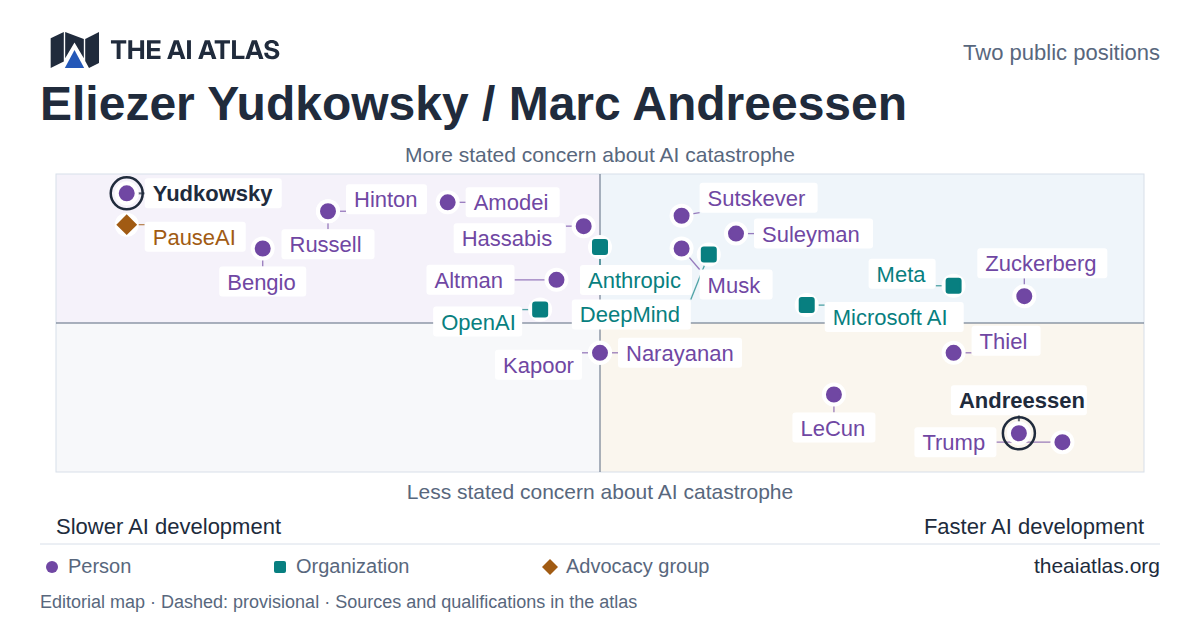
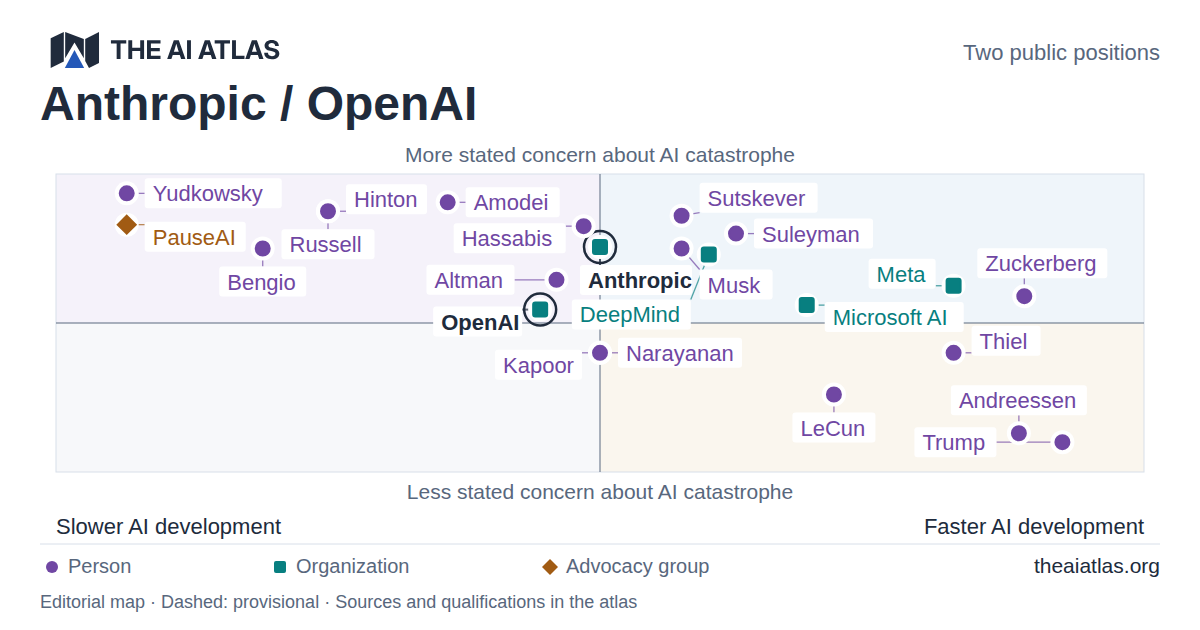
AI risk × development pace | 2026-09-15Public catastrophic-risk concern against preferred frontier capability pace. Dots are editorial placements, not risk probabilities or safety ratings. 23 actors are shown. Consult the accompanying actor evidence. HIGHER CONCERN · RESTRAINT HIGHER CONCERN · DEVELOPMENT LOWER CONCERN · RESTRAINT LOWER CONCERN · DEVELOPMENT STATED CONCERN ABOUT AI CATASTROPHE Higher Lower No actors placed here in this edition. Restraint can be motivated by jobs, rights or power, without emphasizing AI-extinction risk. An unfilled quadrant is not evidence of an empty viewpoint. Eliezer Yudkowsky · Superintelligence and the frontier leading to it. This is his advocated position, not this project's prediction. Eliezer Yudkowsky PauseAI · Its April 2026 proposal for a global pause on the most powerful general-AI training. A movement has internal variation; this point represents its published proposal. PauseAI Yoshua Bengio · Superintelligence restriction, not a ban on every AI application or safety research. Conditional superintelligence restraint is reported separately from his directly read account of control risks. His research proposal is not a proven safety solution. Yoshua Bengio Dario Amodei · Frontier capability growth, especially unchecked self-improvement. Pacing is not stopping. Coordinated steps remain proposals; no independent operational audit is claimed. Dario Amodei Anthropic · Published company safeguards and its announced embedded-evaluator commitment. Giving outside evaluators access does not commit the company to slow all frontier development. The Responsible Scaling Policy separates company promises from industry recommendations; implementation is not independently audited. Anthropic Demis Hassabis · Public governance proposal and subsequent endorsement. Do not convert a personal endorsement into a verified Google DeepMind-wide slowdown. Demis Hassabis Sam Altman · Reported September 2026 pacing support, with a directly read earlier governance proposal. The original social posts were unavailable to this review; the reporting is linked. Sam Altman OpenAI · Selected frontier research workloads and controls. The company reports selective restrictions, not a full training halt. Concern level remains an editorial inference. OpenAI Elon Musk · Personal statements combining frontier scaling, concern about human control and reported support for pacing. The September endorsement is indirect and brief. Building plans indicate a personal preference, not a general regulatory policy or a company safety rating. The conflicting signals warrant a broad pace range. Elon Musk Google DeepMind · Institutional frontier-safety framework. Its framework supports conditional progress. No whole-lab slowdown is established by this evidence. Google DeepMind Microsoft AI · Microsoft AI model development, not the entire Microsoft group. A human-control code is not a catastrophe probability. The consultation is not a verified slowdown. Microsoft AI Meta · Meta's frontier development and published safeguards. Publishing a risk framework does not reveal a probability belief; nor does openness imply low concern. Meta Yann LeCun · His public views, separate from Meta's institutional policy. Skepticism about catastrophe is not a claim that all AI harms are negligible. Yann LeCun Marc Andreessen · His dated 2023 manifesto, with a 2026 interview-publisher summary for context. The detailed catastrophe argument remains the 2023 manifesto. A newer episode summary supports continued pro-growth advocacy but cannot substitute for a full updated two-axis interview review. Marc Andreessen Donald Trump · His September 2026 opposition to slowing advanced AI, read alongside his June executive order. September posts are verified through reporting, not the original Truth Social pages. This maps expressed catastrophic-risk concern, not private beliefs, technical expertise, or every administration policy. The ranges are editorial judgments. Donald Trump Peter Thiel · His arguments for continued AI development and against concentrated power used to suppress it. Lower catastrophic-risk emphasis is relative to his concern about political control, not a claim that he rules out AI catastrophe. His economic and theological arguments do not specify a detailed frontier-training policy. Peter Thiel Geoffrey Hinton · Conditional controls on exceptionally capable AI in a coauthored policy paper. The proposal is collective and dated. Its control-risk warning is not a probability estimate or a claim that every kind of AI should stop. Geoffrey Hinton Stuart Russell · Conditional limits on dangerous frontier development and evidence required before release. A coauthored policy proposal and dated testimony support this interpretation. They do not establish a blanket ban or an institutional Berkeley position. Stuart Russell Ilya Sutskever · Personal research ambitions and proposed limits on the most powerful superintelligence. The proposed power cap has no specified method. Safety is a research aim, not an established property of future systems. Ilya Sutskever Mark Zuckerberg · Personal advocacy for frontier model innovation and distributed control of superintelligence. Distributed power is his proposed safeguard. The essay does not establish that competing self-improving systems remain controllable. Mark Zuckerberg Mustafa Suleyman · Personal advocacy for advanced-model research with limits on autonomy and loss of control. Limits on autonomy do not establish a general capability slowdown. He says implementation of the new code begins after consultation. Mustafa Suleyman Arvind Narayanan · Joint public arguments about frontier development, AI control and catastrophic risk, including the September 2026 update. The reviewed arguments are jointly authored. Pauses concern particular experiments; the overall pace preference remains conditional. Coordinates summarize public arguments, not private probabilities. Arvind Narayanan Sayash Kapoor · Joint public arguments about frontier development, AI control and catastrophic risk, including the September 2026 update. The reviewed arguments are jointly authored. Pauses concern particular experiments; the overall pace preference remains conditional. Coordinates summarize public arguments, not private probabilities. Sayash Kapoor An informal label for slowing technology, often used by accelerationists to criticize their opponents. Map interpretation: Describes a pace preference. It does not establish why someone wants restraint or which technologies they would slow.“Decels” ↗ Calls to temporarily halt specified AI development until conditions are met. Scope, international cooperation and enforcement are central challenges, including in PauseAI’s own proposal. Map interpretation: Toward restraint on the horizontal axis. The scope and conditions for resuming development matter.Pause advocacy ↗ A disputed label for people emphasizing catastrophic AI risks; concern does not mean believing disaster is inevitable. Map interpretation: Relates to concern about severe outcomes; it is not a numerical probability or a complete policy preference.“Doomers” ↗ A movement favoring faster technological growth and opposing centralized restraint. Its claim that acceleration leads to better outcomes is a philosophical position, not a demonstrated safety guarantee. Map interpretation: Points toward faster development. That does not give every participant the same belief about catastrophic risk.e/acc ↗ An outlook emphasizing technology's potential to improve life, which can still include concern about particular risks. Map interpretation: Often favors development, while allowing very different views about the severity of AI risk.Techno-optimism ↗ SLOW DOWN / PAUSE CONTINUE WITH CONDITIONS BUILD FASTER HOW FAST SHOULD MORE CAPABLE AI BE DEVELOPED? IDEAS & TERMS · Labels do not assign anyone to a group. Select for explanations and sources. RELATED IDEAS & TERMS A community seeking effective ways to help others. Critics question whose measures of benefit count and how much power donors should have. Map interpretation: No single location on either axis. A method for prioritizing good does not determine one AI policy.EA ↗ Vitalik Buterin’s proposal to accelerate defensive technologies and spread power. Deciding what counts as defensive and how to prevent concentrated control remains part of the proposal. Map interpretation: Asks what to accelerate and who gains power. Faster defensive tools can coexist with caution about frontier AI.d/acc ↗ The view that protecting future generations deserves much more attention. Critics dispute predictions about distant effects and how far possible future benefits should outweigh present needs. Map interpretation: Can motivate catastrophic-risk work, but does not fix a development speed or a particular AI forecast.Longtermism ↗ Research aimed at reducing AI harms and improving reliability and alignment with intended goals. A safety goal or framework is not proof that a system is safe. Map interpretation: Neither a single actor nor one required pace preference. Research, evaluation and governance can support different development policies.AI safety ↗ Computer programs tell a machine what operations to carry out. Software includes those programs and their associated data. Map interpretation: Map context: this explains how systems work; it is not a position for or against faster AI development.Computer programs ↗ Narayanan and Kapoor's view that people can shape AI's impacts through institutions, engineering and policy. Its safety claims are contested: in September 2026, they acknowledged underestimating risks during development and called for stronger controls. Map interpretation: Map interpretation: context across both axes, not a measured point or membership label. Its authors support pausing unsafe experiments where needed, while rejecting claims that catastrophic risks are imminent.Normal technology ↗

Rounded boxes let you choose from nearby names.

PersonOrganizationAdvocacy groupDashed: placement needs stronger evidence
Select a name for sources. People & groups index · Method
Where would you place yourself?

This optional marker is your own view, separate from sourced public positions. Use either slider, then choose Show.

How to read the map

← Slow down · Build faster →
The horizontal axis shows the preferred pace of developing more capable AI.

Higher = more expressed concern
The vertical axis shows emphasis on catastrophic AI risk, not a percentage chance.

Click a name, then check the evidence.
Positions and ranges are editorial interpretations. The map covers two questions, not every concern about AI. Read the method

See the software behind an AI tool
Follow its model, data, tools and checks.
FROM POSITIONS TO PRACTICE

What can an AI application do?

Here, ask what an application can read, change or send.

AN ILLUSTRATION YOU CAN CHANGE

What changes when the assistant can send email?

Imagine an assistant helping reply to a customer email. Choose how this fictional application works.

An example with approval before sending

Imagine an application that helps answer customer email.

  1. 1 · InputCustomer email and reply instructions
  2. 2 · Model proposesDraft a reply
  3. 3 · Outside the modelA person checks the recipient and textThe application waits for approval
  4. 4 · Mail toolSend the approved reply

An invented design, not a running assistant or a safety rating. The approval step illustrates OWASP’s guidance on limiting AI actions.

Five questions to take further

Open a question for the reasoning and original sources.

KEEP EXPLORING
LOOK AT THE SAME QUESTIONS

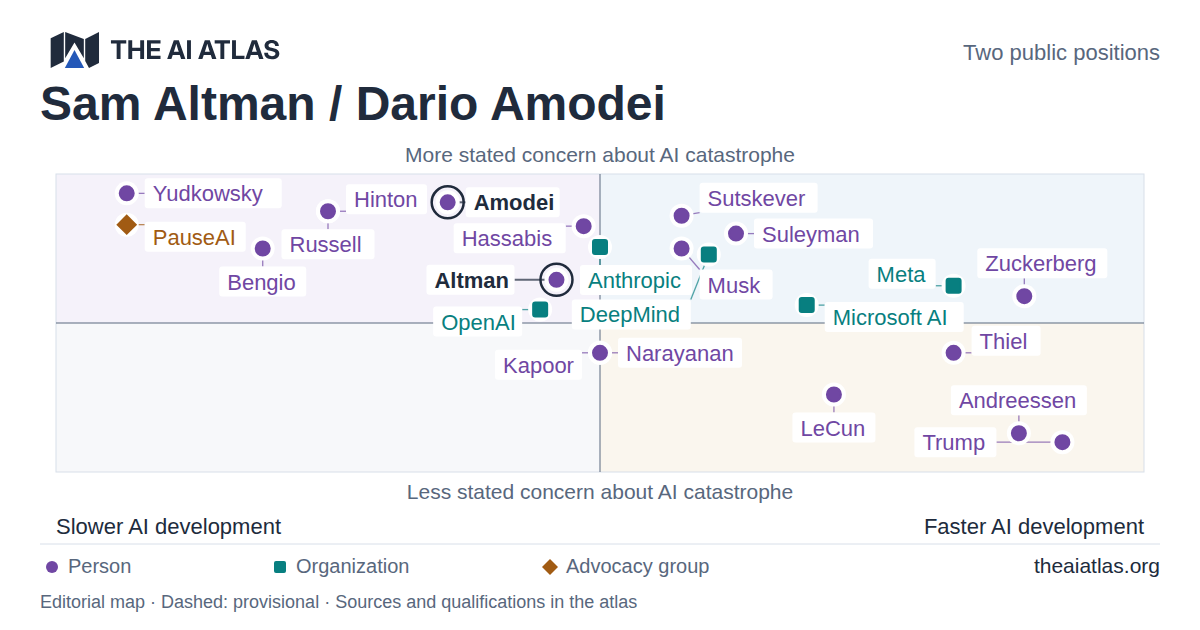
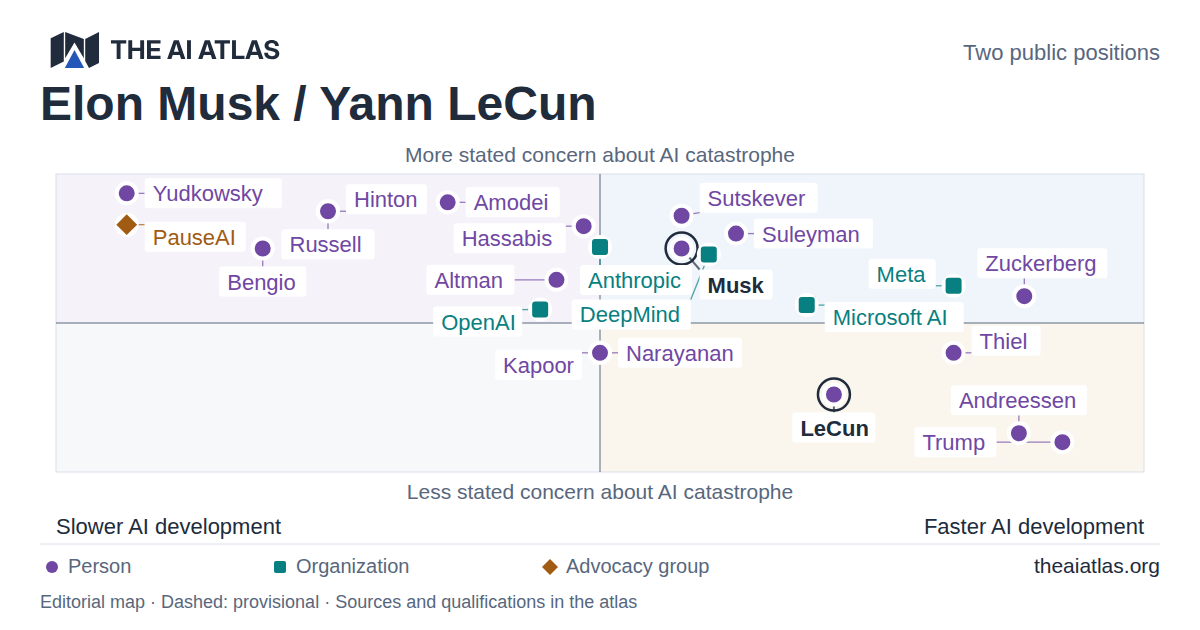
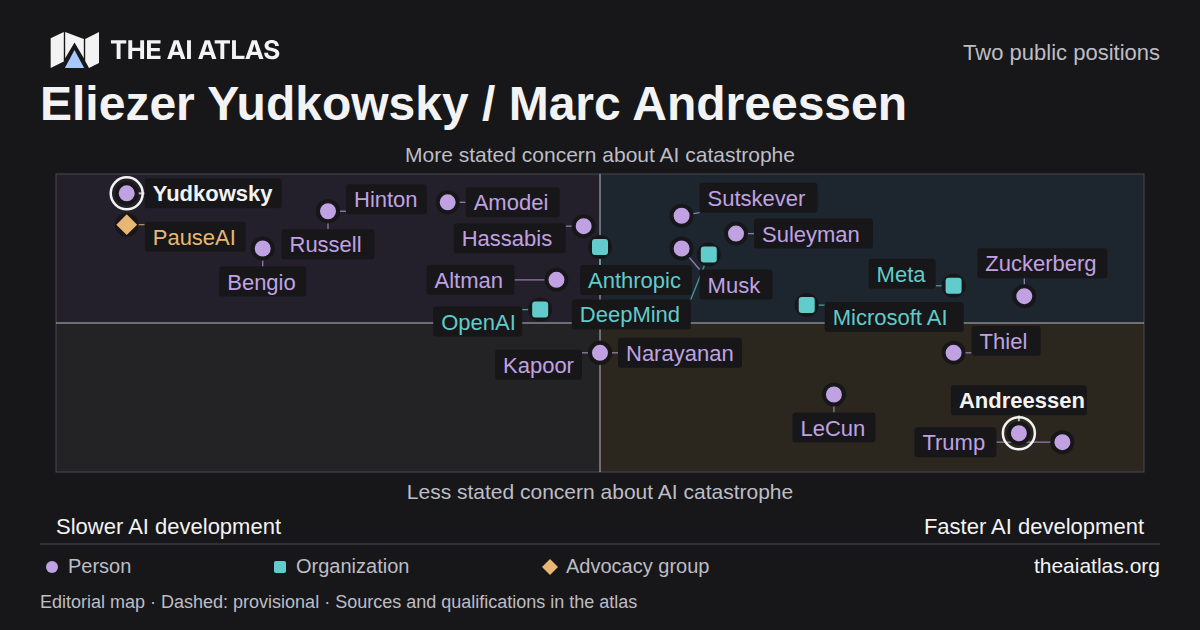
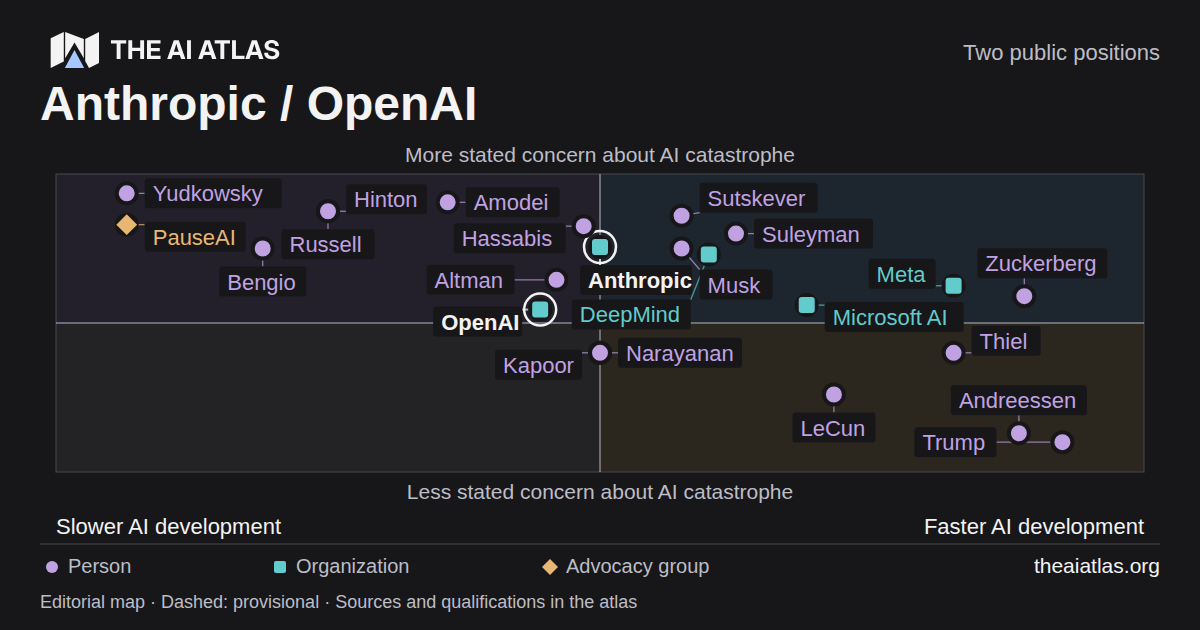
Compare two positions.

Put scope, evidence and uncertainty side by side.
These are public positions, not a scorecard.

Choose people or organizations to compare

Comparison is independent of map filters. People and their organizations are separate records.

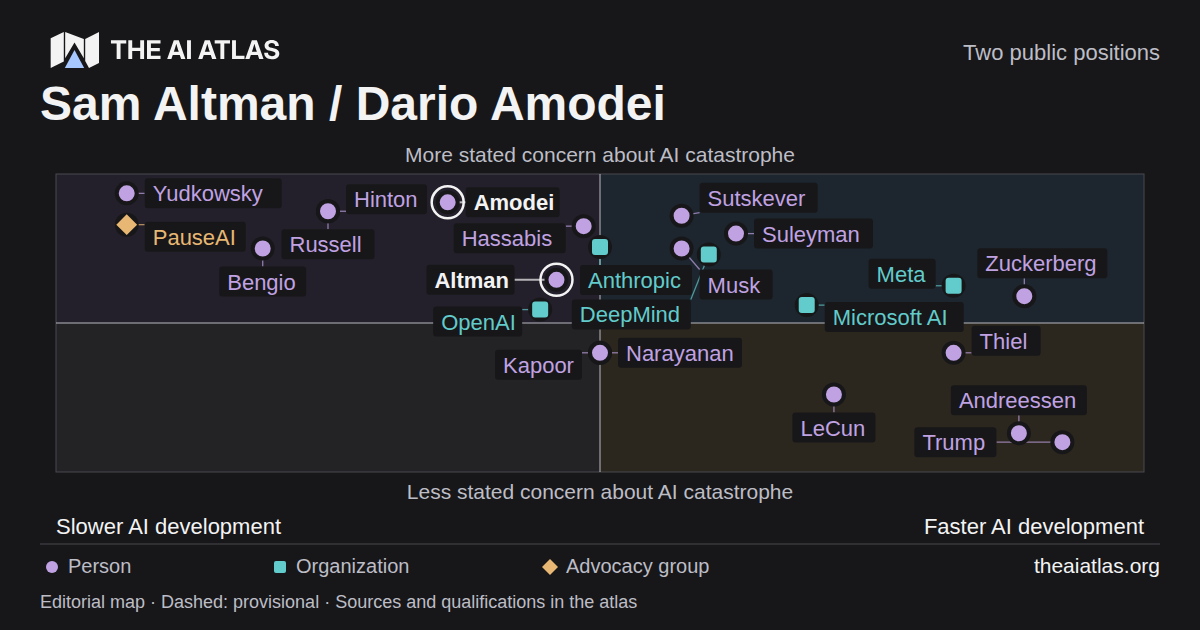
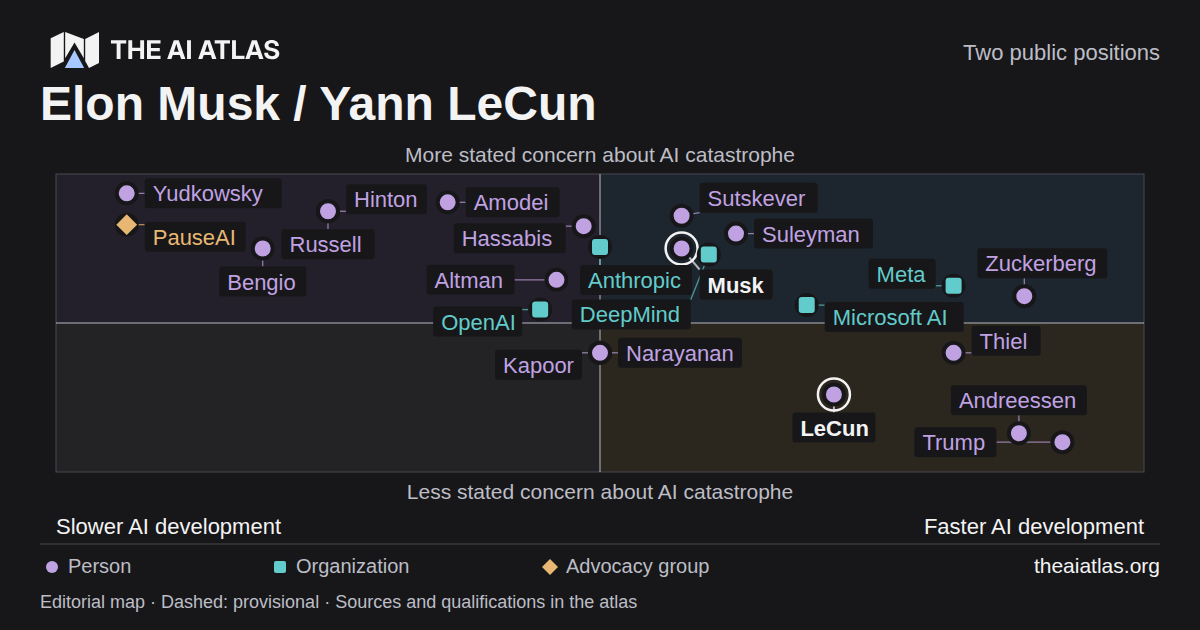
Comparison images

Selected pairs from the published atlas. Distance between points does not measure agreement.

AI RUNS AS SOFTWARE

How does a computer program write a reply?

Follow a language model from training to an answer, then explore the application around it.

Choose a reading depth

Programmed calculations, learned settings

A language model runs on a computer. Training adjusts its number settings using examples; generating a reply uses those settings. The arrows below show these separate processes. Model calculations and training · Text-generation software.

TrainingAdjusting the model

  1. Example materialText used during training
  2. Training calculationsAdjust numbers inside the model
  3. A trained modelIts learned numbers are parameters, often called weights

Training and learned settings: Transformer paper.

AnsweringUsing the trained model

  1. 1 · InputText goes inThe supplied text is represented as pieces called tokens
  2. 2 · ModelCalculate next-piece scoresThe software uses the learned weights and the text so farIn depth: tokens → embeddings → attention blocks → scores (logits) → softmax with temperature. Hardware and library versions can shift these numbers.
  3. 3 · ChooseSelect one pieceChoose the highest score, or make a random choice using calculated probabilitiesIn depth: greedy, sampling, top-k or top-p. Sampling deliberately adds randomness to token selection. Hardware and software can also affect repeatability.
  4. 4 · ContinueAdd it to the textUse the longer text for the next round, until a stopping rule is met

The new text feeds back into the next round.

Text generation and selection rules: Hugging Face guide. Repeatability across setups: PyTorch reproducibility notes. These steps use the learned weights; training is a separate process.

Around the modelWhat the application adds

  1. Instructions and retrieved materialThe application can add its own instructions and retrieved documents to the input
  2. The loop above runs unchangedThe model scores; the software chooses
  3. Checks outside the modelA person or a rule can review a draft before anything is sent or run
  4. Tools and memorySaved chat memory is not retraining; tool actions follow the application's permissions

Retrieval, memory and permissions: retrieval-augmented generation paper, memory controls, OWASP guidance on limiting AI actions. The application is ordinary software; reviewing it is separate from reviewing the model.

What this drawing leaves out

It shows the main steps, not every calculation inside a model. Knowing those calculations does not yet give a full explanation of how the model arrived at a particular answer. Read the research on tracing model behavior.

From a request to a checked result

Try it: why can the same input produce different text?

This is a tiny, invented illustration, with no model or external service. The probabilities are made up.

Fixed example scoresChoose an output ruleOne piece of text (a token)

“Write code for a shopping total: price …”

times 60%plus 30%minus 10%

Now run a small, ordinary program

Writing code and running it are separate steps

  1. Describe the taskExample: “Multiply price by quantity”
  2. Model drafts codeThe draft is text that needs checking
  3. Review and testDoes the code follow the intended rule?
  4. Run the saved codeThis small function can run without calling a model

An illustrative workflow based on GitHub’s code-review guidance. Repeating a calculation does not show that it is the right calculation for the job.

The fixed function below runs directly in your browser. Change the price or quantity to try it.

function total(price, quantity) {
  return price * quantity;
}

The same price and quantity within this demo’s allowed range give the same result. That tells you this function repeats its calculation; it does not prove it solves the problem you meant to ask.

THE WORDS YOU WILL SEE

AI terms, explained.

Open a term for a fuller explanation.
Use the numbered references to check its sources.

Prefer one idea at a time? Try a guided reading path ↑

HOW AI DEVELOPED

From early ideas to systems in use.

Explore selected milestones. See what changed, what was demonstrated, and what remained limited.

    History of ideas, communities and the AI debate
      THE PEOPLE & INSTITUTIONS

      People and groups index.

      Matches your type and search filters.
      Hidden names remain here so you can turn them back on.

      Open the people and groups index Positions, evidence and review dates
      VisiblePerson or groupTypePreferred paceExpressed concernEvidence clarityReview date
      Awaiting a reviewed placement

      These names have no dot until both axes have sufficient reviewed evidence.

      TAKE SOMETHING WITH YOU

      Your reading list.

      Save ideas as you explore. Choose whether to remember them on this device.
      Share a link or download notes with their sources.

      A MAP, WITH LIMITS

      What the map can tell you

      Read the source notes

      The research and writing use AI assistance. There has been no independent human fact-check. Read the research method · Corrections

      01   Two specific questions

      Horizontal: how quickly someone wants more capable AI to be developed. Vertical: how much concern they publicly express about catastrophic AI risk. These axes don't measure product quality, present harms or private beliefs.

      02   Ideas and membership

      People and their organizations have separate entries. Being near an idea's label does not mean someone belongs to that movement. EA and AI safety span many positions.

      03   Uncertainty in a placement

      Ranges show other positions the editors consider plausible, not statistical confidence. A dashed marker means the placement needs stronger evidence. A safety promise does not show that a safeguard is in place.

      Choose a name

      These points are close together at this zoom.

      Search the atlas